What Is the Shortest Verse in the Bible?
John 11:35, “Jesus wept,” is traditionally known as the shortest verse in the Bible in many English and Portuguese translations. Explore the context of Lazarus’s death, why Jesus wept, and what these two words reveal about Christ’s true humanity, compassion, and power over death.
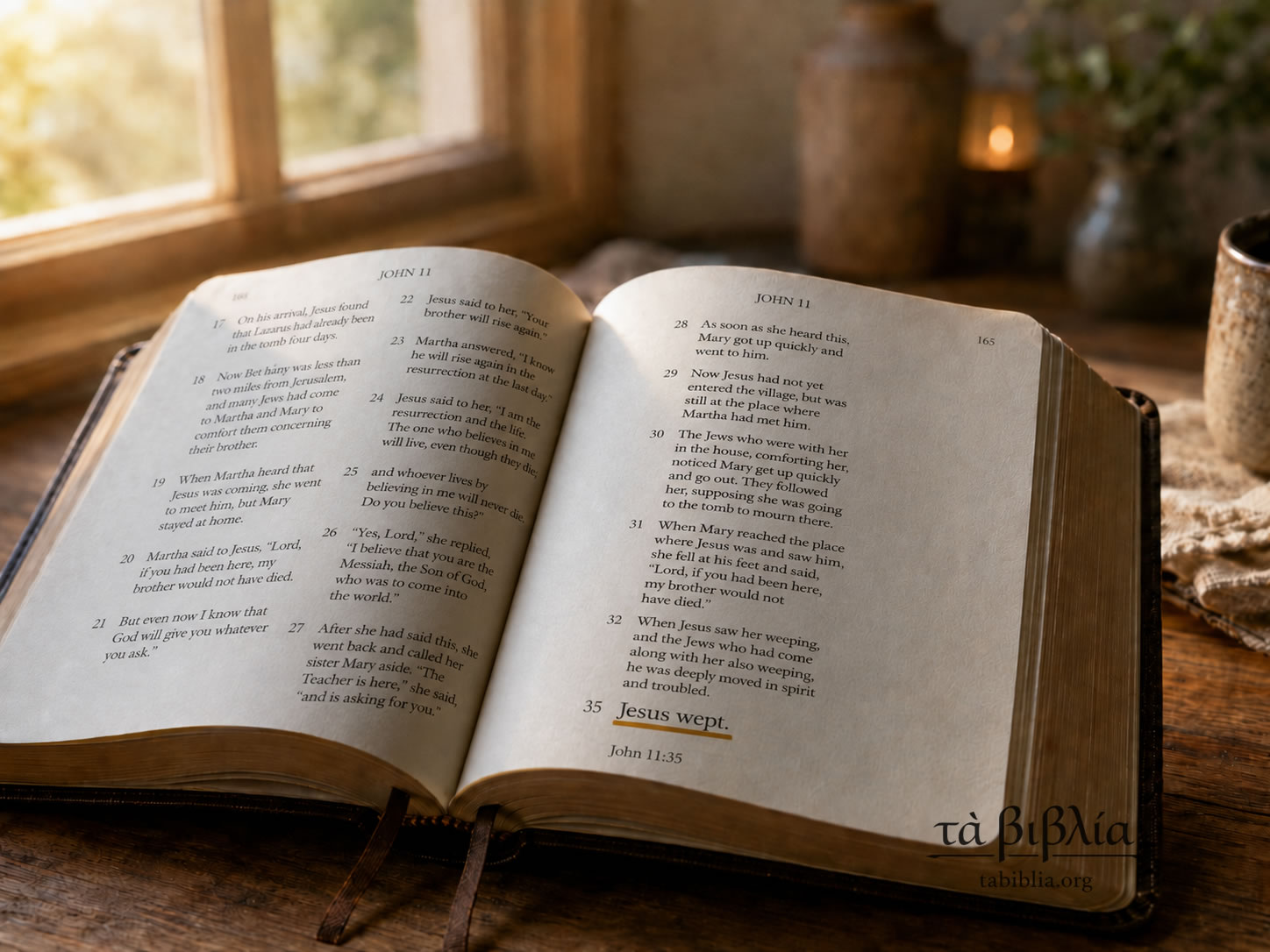
John 11:35, “Jesus wept,” is traditionally known as the shortest verse in the Bible in many English and Portuguese translations. This classification may vary depending on the language, translation, and method used to count words or letters.
Yet John 11:35 is far more than a short sentence. These two words reveal the true humanity of Jesus Christ, His deep emotion in the face of sorrow, and His compassion for those who suffer.
Therefore, although the best-known answer to the question “What is the shortest verse in the Bible?” is John 11:35, it is important to consider the differences among languages, translations, and counting methods.
Is John 11:35 the shortest verse in the Bible?
In many English and Portuguese Bibles, John 11:35 is traditionally recognized as the shortest verse. The text says:
“Jesus wept.”
To understand the depth of these two words, we need to consider the setting in which they appear. The sentence is part of the account of the death and resurrection of Lazarus, the brother of Martha and Mary, a family dearly loved by Jesus.
The biblical context of “Jesus wept”
John 11 tells us that Lazarus was sick. His sisters sent a message to Jesus, saying that the one He loved was ill (John 11:3). Even after receiving the news, Jesus remained where He was for two more days before traveling to Bethany.
By the time He arrived, Lazarus had already been in the tomb for four days. Martha went out to meet the Lord and expressed her grief, saying that if Jesus had been there, her brother would not have died. Shortly afterward, Mary also came to Him weeping, accompanied by others who shared in their mourning.
When Jesus saw Mary and those with her weeping, He was deeply moved. It was in this setting of real loss, sorrow, and grief that John recorded: “Jesus wept.”
Before raising Lazarus from the dead, Jesus declared to Martha: “I am the resurrection and the life.” This statement shows that the Christian hope is not merely an idea about the future, but is found in the Person of Christ Himself.
Afterward, Jesus went to the tomb, commanded that the stone be removed, prayed to the Father, and called Lazarus to come out. The man who had been dead came forth, and many who witnessed the sign believed in Him.
The resurrection of Lazarus revealed the identity and glory of Jesus, but it should not be understood as a promise that every instance of suffering will end through a similar miraculous intervention in this life. The account reveals both Christ’s sovereign power and His compassion in the face of human sorrow.
What does “Jesus wept” mean?
John 11:35 is brief, but it presents profound truths about Jesus Christ. Its meaning can be understood through three main aspects.
Jesus is truly human
The tears of Jesus confirm His true humanity. He did not merely appear to be human; He truly experienced human life. He felt weariness, hunger, sorrow, and anguish, yet He never sinned (John 4:6; Matthew 4:2; 26:37-38; Hebrews 4:15).
According to the historic, biblical Christian faith, Jesus is truly God and truly man. In John 11, His humanity is movingly displayed as He weeps, while His divinity and power are revealed when He calls Lazarus out of the tomb.
Jesus has compassion for those who suffer
This verse also reveals the compassion of Christ. Jesus did not treat the grief of Martha, Mary, and those with them as something insignificant. Although He knew what He was about to do, He did not remain distant, cold, or indifferent.
Jesus saw their tears, heard those who were grieving, and remained present in the midst of their mourning. The Lord who has authority over death also draws near to wounded hearts with grace and mercy.
Tears do not mean a lack of faith
“Jesus wept” shows that genuine faith does not require emotional numbness. Jesus knew that He would raise Lazarus from the dead, and yet He wept. His tears were not a sign of despair or a lack of faith.
The Bible does not forbid mourning, although it teaches Christians not to grieve as those who have no hope (1 Thessalonians 4:13). It is possible to trust God while still feeling deeply the pain of loss, a difficult season of waiting, or a painful situation.
Jesus is the resurrection and the life
The tears of Jesus are not the end of the account. John 11 moves toward the resurrection of Lazarus, a sign that points to Christ’s authority over death and confirms His declaration: “I am the resurrection and the life.”
Jesus is powerful, but He is not indifferent. He knows the end of the story, yet He still cares about the suffering experienced along the way. In Him, compassion and power are never separated.
The resurrection of Lazarus was temporary, since he would eventually die again. The Christian’s ultimate hope, however, rests in the resurrection and eternal life promised to those who believe in Christ (John 5:28-29; 1 Corinthians 15:20-26).
Is there an even shorter verse?
The answer may vary depending on the language, translation, edition of the biblical text, and method used.
Counting words does not always produce the same result as counting letters. In addition, the original biblical languages have structures that differ from those found in English or Portuguese.
In English, for example, John 11:35 is especially notable for its brief wording in the King James Version: “Jesus wept.” In the Greek text and in other translations, however, different counting methods may produce different results.
For this reason, the most balanced answer is that John 11:35 is traditionally known as the shortest verse in the Bible in many English and Portuguese translations. Its importance, however, does not depend merely on its brevity, but on what it reveals about Jesus Christ.
Applications for the Christian life
John 11:35 speaks to the hearts of those going through difficult times. The Christian life is not a journey without tears. The Bible itself presents men and women of faith who faced grief, fear, persecution, confusion, and seasons of intense suffering.
The Christian faith does not deny pain. Instead, it enables believers to face it in the presence of God, sustained by the work of Christ and the hope of the resurrection. Jesus is not indifferent to sincere tears. He knows our sorrows and mercifully receives those who draw near to Him in the midst of suffering.
This verse also teaches the church to be more compassionate. Scripture commands us to “weep with those who weep” (Romans 12:15). Not every sorrow needs to be answered with lengthy explanations or ready-made phrases. In many moments, the most Christlike response is simply to remain beside those who suffer, listen to them, receive them with care, and pray with love.
The text also corrects a mistaken view of spirituality. Being spiritual does not mean being insensitive. Having faith does not mean never crying. Trusting God does not require pretending that pain does not exist. Jesus Himself wept, and His tears did not diminish His holiness, His authority, or His mission.
The compassion revealed at the tomb of Lazarus is consistent with the whole mission of Christ. Jesus not only showed compassion in the face of human suffering, but also willingly went to the cross, where He gave His life as a ransom for many and bore the sins of those who believe in Him (Mark 10:45; 1 Peter 2:24).
Conclusion
The best-known answer to the question “What is the shortest verse in the Bible?” is John 11:35: “Jesus wept.” Although the result may vary according to the translation and counting method, this text remains traditionally recognized as the shortest verse in many English and Portuguese Bibles.
More important than its brevity is what these two words reveal. Jesus is truly God and truly man. He has power over death, yet He is not distant from human sorrow. He sees our tears, has compassion for those who suffer, and offers everyone who believes in Him the ultimate hope of resurrection and eternal life.
“Jesus wept” is a short sentence, but it carries an immense message about the humanity, compassion, and power of Christ.